Monday, June 13, 2011

God and Morality


In the second chapter of Value and Virtue in a Godless Universe Wielenberg critiques theistic ethics and argues for a basic account of naturalistic ethics. I will focus on the later.

God as the Source of Ethics? Naturalism as the source of Nihilism!
Some philosophers argue that God is the source of all moral duties and commands and that as a consequence of this, the naturalistic framework cannot account for objective moral values. Wielenberg argues that this is false because "we have some moral obligations that derive from our relationship with other human beings and we have other moral obligations that derive from intrinsic values." I will only focus on the first, and quickly sum up the second.

God as a Divine Commander
Many, if not most, theists believe that moral obligations arise out of Gods commands.Wielenberg contests this for two primary reasons. The first is that although God can and may be the source of some moral obligations he cannot be the source for all moral obligation. This is because for God to command an action x he must have the right credentials and go through a proper process. Divine Command theorists suggest that a person x must obey God because he is an all-good God, these are the proper credentials for an ethical command. Wielenberg has no qualms with this. But for an all-good God to command an action or moral obligation via a sign is not enough to establish a moral condition. God must make sure that the receiver of the command, understands that the sign is from her. Wielenberg illustrates this as such:
"Suppose your friend (call him "Dave") sends you an anonymous note. The note reads: "Loan Dave your Car"...Are you now morally obligated to loan Dave your car? The answer clearly enough is no, and it is not hard to see why: You have no idea who issued this command. More specifically, you don't know that the command was issued by dave. Moreover, Dave (We may reasonably suppose) knew that you would not be able to tel who issued the command. In these circumstances, it seems clear that Dave, despite being capable of imposing on you the obligation to loan him your car, has failed to do so in the case at hand. He has failed to do so because he has failed to recognize that the command is coming from a legitimate source."
So now a argument can be constructed to show that not all moral obligations derive from God's commands:
1. When issuing a command which instills moral obligation, God must show that the command comes from a legitimate source, namely, himself.
2. Naturalists have moral obligations.
3. But naturalists do not recognize God's existence, let alone her commands.
4. Therefore, God cannot be the source of all the naturalists moral obligations.
There may be some objections to 3, perhaps the naturalists does not recognize that God exists or that she has issued a command because of some moral or rational fault of their own. But it doesn't at all seem controversial to suppose that there are reasonable naturalists.That is, naturalists who are in a position where they may be epistemically justified in the belief that God doesn't exist. Well perhaps that is a bit controversial, but remember that Wielenberg assumes that naturalism is true in this book and is only seeking to establish that if naturalism is true then there exists value and virtue! He does not argue for the truth of naturalism. Thus saying that the naturalist is suffering from a significant defect (spiritual, moral, or rational) would be to beg the question of God's existence. So through all this I think one could establish that if naturalism is true there still exists moral obligation.

Necessary Moral Truths
Some things are contingent (they could or could not exist) and others are necessary (they cannot not-exist). The typical example of a necessary truths is 2+2=4. It must be the case that 2=2+4. In the same way the naturalist cannot insist that it must be the case that pain is bad. Pain may lead to good things, but it is in and of itself bad. It is intrinsically bad and it could not be otherwise. God could not make the badness of pain go be a goodness, because the badness of pain is not contingent it is necessary. Thus it is the case that the naturalist can insist on moral truths that derive are true in virtue of their intrinsic and necessary nature.
This I think constructs a basic case for the existence of moral facts in the naturalistic framework, that is quite successful.

Saturday, June 11, 2011

God and the Meaning of Life

In the first chapter of Value and Virtue in a Godless Universe Erik Wielenberg considers three arguments that render life in a Godless universe meaningless. He ultimately rejects them all by offering three different "theories of meaning" by Aristotle, Richard Taylor, and Peter Singer.

The Meaning of Life
Wielenberg identifies three ways in which life may have meaning. It may have supernatural meaning that is "purpose that is assigned by a supernatural being." Or it may have external meaning, when a life has meaning if "the universe is better than it would have been had the life not been lived." Or finally internal meaning. If a life has internal meaning; "the individual is better off having lived than had that person never existed at all. Moreover, the life is one in which something worthwhile is accomplished it is a life that has a point. It is the urge to live a life like this that is revealed in the expression "I want to do something with my life.""
Though there are reasons to squabble with these definitions of meaningfulness, for the purpose of the summary I will assume that they are for the most part correct, which I think is true.

Arguments that Life Lacks Internal Meaning Without God
Wielenberg gives three arguments which conclude that life is meaningless without God, they are the final outcome argument, pointless existence argument, and the nobody of significance cares argument.

Final Outcome Argument (Hereafter FOA)
FOA goes something like this: if there is no God, and no immortality then the final outcome of life makes it meannigless. Because the universe will inevitable become extinct, either in a heat-death or something else like life will lead to nothing of significance or value. Because everyone dies life is absurd.

Pointless Existence Argument (Hereafter PEA)
PEA follows the proposition that "life only has meaning if it has supernatural meaning." Without an assigned goal by a supernatural agent life is pointless.
 
Nobody of Significance Cares Argument (Hereafter NSCA)
NSCA can be put as follows: "a life has meaning only if a suitable significant being cares about or takes an interest in that life." If God loves us life has meaning, but if she doesn't exist she can't love or care for us thus life is meaningless.

In response to these arguments Erik ponders offers three different theories of meaning

Creating Your Own Meaning
Wielenberg begins with Richard Taylor's response to these arguments in the last chapter of his book Good and Evil. The sum of Richard's view is that life can have internal meaning if a persons desires and activities correspond with each other. He mentions the famous case of Sisyphus. Sisyphus was condemned by the Gods and "sentenced to an eternity of frustration." He must roll a large rock up a hill for all eternity, and every time he gets to the top of the hill, the stone rolls down again. Clearly this is not initially a meaningful activity. But Taylor asks what if Sisyphus enjoyed rolling the rock up the hill? What if he had the desire to roll the rock up the hill for eternity and this desire was satisfied by his activity? Then Taylor argues Sisyphus's life would have internal meaning.
To FOA and NSCA Taylor would respond that the end situation and whether any one cares or not has no relevance to meaning, they represent improper criterion. To PEA Taylor would say that you create your own meaning, and don't need supernatural guidance or commands when doing so.
But Taylor's account is clearly not without problems, if objective values exist then some things are meaningful whereas others probably are not. Wielenberg has us compare the case of a jazz musician who loves what he does and a grinning excrement eater who feels the same about his existence. Even though both of their desires correspond nicely with their activity it seems as though the jazz musician lives a much more meaningful life. If objectively some activities are better then others then it would certainly be the case that being a jazz musician is better then being a excrement eater, whether you like it or not. Thus if  objective values exist we have good reason to say that Taylor's account is wrong. If there are no such things, then Taylor's idea of meaningfulness can be of use.

Meaning Through Eliminating Pain
The second conception of how a human life can have internal meaning is constructed by Peter Singer and analyzed by Wielenberg. Singer's view is that "we can live a meaningful life by working towards goals that are objectively worthwhile." Singer takes pain to be intrinsically bad, and thus the elimination of pain is objectively worthwhile. As Erik explains "At the heart of Singer's view then, is this principle:
(S) An activity of S's, A, has internal meaning for S just in case (i) in doing A, S is trying to accomplish goal G, (ii) G is objectively worthwhile, and (iii) A in fact leads to G."

So a life is meaningful for a person who is spends their life trying to eliminate pain. Under Singer's view a life could also have internal meaning for a person who spends their life trying to create pleasure for other people, as long as that pleasure is objectively worthwhile.
In reply to FOA Singer can respond that that argument fails because it arbitrarily puts to much emphasis on the future as opposed t other present. He in fact says this
"We should not, however, think of our efforts as wasted unless they endure forever, or even for a very long time. If we regard time as a fourth dimension, then we can think of the universe, throughout all the times at which it contains sentient life, as a four-dimensional entity. We can then make that our-dimensional world a better place by causing there to be less pointless suffering in one particular place, at one particular time, than there would otherwise have been...We will have had a positive effect on the universe."
Wielenberg quotes Paul Edwards who says, that FOA fails because of a "curious and totally arbitrary preference of the future to the present." PEA fails because it doesn't matter whether eliminating suffering is mandated by God or not. It is still objectively worthwhile. And to NSCA Singer can say that actually significant beings do care! The beings whose suffering is being decreased care very much indeed and surely they are significant! 
So although Singers theory could use a bit more support it comes out as a substantial improvement over Taylor's.

Intrinsically Good Activity
Wielenberg finishes with Aristotle's view. "Aristotle divides activities into two categories--those that are good because of what they produce, and those that are good in and of themselves." His "insight" is "Some activities are intrinsically good." That is these activities are good even if they lead to nothing of value. So "That suggests a third way of bringing internal meaning to ones life: Engage in intrinsically good activities, activities that are worth doing for their own sake." I think this is a satisfying idea of meaning, but are their such activities that are intrinsically good? I am not sure if there are, to be more specific I am strictly agnostic about the manner. I don't think there are any good reasons for thinking there are not intrinsically good activity's or very good reasons for thinking that their are. Perhaps the burden of proof falls on the person who claims that their are such values? At any rate Wielenberg lists includes such activities as "falling in love, engaging in intellectually stimulating activity, being creative in various ways, experiencing pleasure of various kinds, and teaching." How do you find these intrinsic activities and values? He suggests using "a version of G. E. mores isolation test... To see if an activity is intrinsically good, consider whether you would find it worthwhile even if it had absolutely no consequences." Aristotle's theory can dispense with the arguments against meaning in a godless universe in a similar way that the previous theories did so; FOA, PEA, NSCA all do not use the proper criteria of meaning and are not relevant. I think the challenge of this idea is to somehow show more conclusively that their are intrinsic activities. Either way whether God exists or not has nothing to do with whether there are or not. Thus this idea can be seen as a useful theory of meaning in a Godless universe.


Friday, June 10, 2011

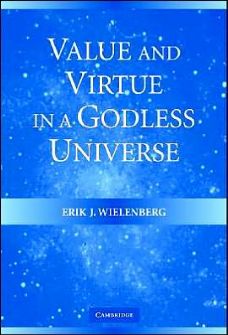
Value and Virtue in a Godless Universe

I am going to do a post series on Wielenberg's Value and Virtue in a Godless Universe. I found this to be a very informative and readable work on the ethical implications of naturalism. It deals with popular theistic arguments against the implications of naturalism for morality and meaning. In conclusion of my reading, I will summarize each chapter of the work and include my own additional thoughts on the matter. Also to be included are two papers by Wielenberg "In Defense of Non-Natural, Non-Theistic Moral Realism" and "On Evolutionary Debunking Arguments"
The posts are as follows:
1. God and the Meaning of Life
2. God and Morality
3. Divine Guarantee of Perfect Justice
4. Ethical Character in a Godless Universe
5. Creeds to Live By
6. In Defense of Non-Natural, Non-Theistic Moral Realism
7. On Evolutionary Debunking Arguments

Wednesday, June 8, 2011

Why Christians ought to be Vegetarian

Many people are of the opinion that if one is a Christian one is not obligated to be a vegetarian, nor is it even supererogatory to be a vegetarian.This argument can be challenged in several ways, here I will offer one quick argument to the contrary:

1. In the perfect state of nature humans are vegetarian
This is shown by the vegetarian diet in the Garden of Eden before the fall, and as well as "prophetic"   verses concerning the lion and the lamb getting along nicely. In other words before the fall, and in "heaven" humans were and will be vegetarian. I think this is fundamentally correct, and see no problems with this premise.

2. In the perfect state of nature humans were closest to God (had a better relationship w/ God, etc.)
This premise can be modified in multiple ways, what is important is that in the perfect state of nature the Christian can better fulfill their calling and purpose as a Christian. In other words it would have been preferable for humans, not to fall and to remain in the perfect state of nature.

3. As a Christian one ought to be close to God
This premise can also be modified in the same manner as 2.

4. Therefore, as a Christian one ought to emulate the perfect state of nature.

5. Hence, as a Christian one ought to be vegetarian.

I think this is a legitimate argument. I can think of a few objections, one is that in the Bible people frequently eat meat. For this objection to work it would have to be rephrased along the lines of, God condoned x as morally permissible therefore x is morally permissible (as opposed to the clearly fallacious: person x does y in the Bible therefore y is morally permissible.) At no point that I am aware of does the Christian God say that eating meat is morally obligatory, only that it is permissible. Later on the apostle Paul seems to contradict himself with Romans 14:21:
"It is better not to eat meat or drink wine or to do anything else that will cause your brother to fall."
and Romans 14:02:
"One man’s faith allows him to eat everything, but another man, whose faith is weak, eats only vegetables."
These two verses can be interpreted in multiple different ways and have been used to argue both for Christian vegetarianism and against it. I am not sure that any one make any ground on this argument (here is a short rebuke of Rom 14:02), at any rate lets assume that eating meat is neither obligatory nor forbidden and likewise for vegetarianism. How does this affect the argument? It may mean that it is not obligatory for a Christian to be vegetarian. I am not sure if I follow this objection, but lets consider it valid. All this establishes is that the it is permissible for a Christian to be a meat eater, but it would be better if they practiced vegetarianism. In other words it is supererogatory that Christians be vegetarianism if this objection is correct. In other words if eating meat is permissible, then being vegetarian is not obligatory, but it still may be better.

I think if the advocate for Christian vegetarianism is to overcome this objection they may do this by making a crucial distinction. God (and Paul and whoever else) say that eating meat is permissible after the fall, this is not to say that it is desirable. In other words humans ought not have fallen, this being the case things that are permissible after the fall, may not really be ultimately permissible. Thus it is ultimately the case that Christians ought to be vegetarian.

I am not yet convinced if this argument works, I think I will try it and see what people say in response. It may ultimately come down to theological interpretation and whatnot.

Monday, June 6, 2011

A few objections to Vegetarianism

What follows is a modified excerpt from one of my papers on vegetarianism:

"...Some people are convinced that it is natural to eat meat and therefore it is morally acceptable to eat meat. But this obviously does not follow, simply because something is natural doesn’t change it’s moral status. It is not even clear how to interpret the word natural, since it seems like everything is in a sense natural, but certainly not everything is morally acceptable. Perhaps the word natural is being used to say that humans to have evolved to be omnivores, but again simply because we have the ability to eat meat doesn’t mean that it is acceptable, for we have the ability to do many bad and naughty things. Others believe that vegetarianism leads to absurd consequences these thoughts go like this: “suppose that we are obligated to reduce animal suffering then shouldn’t we interfere with the predation of other animals eating animals? But that would be absurd!” However this objection includes its own refutation, if it is absurd to meddle with predation then clearly we aren’t obligated to do so. This has no relevance whatsoever as to whether we should be vegetarians or not. Further if our technology and scientific knowledge continues to advance at it’s current rate then perhaps someday it will not be absurd to interfere with nature and then we can and should take steps to reduce suffering in the wild. Until then we should reduce animal suffering through vegetarianism. Some people think that animals are completely devoid of animal rights for a variety of reasons, but I am not sure how this affects my arguments. These arguments had nothing to do with what species an organism is or how rational they are, these principles extend to all sentient beings. Although I am quite skeptical of rights based approaches to morality, it seems that if infants and the mentally disabled have any rights animals should have at least some rights as well. Another objection also has to do with animal rights, it is said “since the farmer gave the animal life the farmer has the right to kill it.” However this is generally not how we think about rights, for example when parents give life to a child they certainly do not have the right to kill it once the child has ripened. If animals have a moral status, their good and bad experiences should be considered morally relevant, and this cannot be superseded by some vague version of rights. Some people examining the gargantuan and deplorable number of animals slaughtered return hopeless thinking that becoming a vegetarian won’t change anything. But this is false, it is estimated by that the average vegetarian saves 35-50 animals from being slaughtered a year. Finally people insinuate that a vegetarian diet is not healthy. Not surprisingly this is also false, simply read the statement by American Dietetic Association that mentions vegetarian diets “are healthful, nutritionally adequate, and may provide health benefits in the prevention and treatment of certain diseases.” Although there are many other objections to vegetarianism I am led to conclude that they are all failures in the same fashion of the objections just discarded."

Clearly some of these objections could have been considered in more detail and there may be more which demand attention. There will probably be more posts analyzing objections in more detail in the future.

Saturday, May 21, 2011

Analogy Argument: On "Puppies, Pigs, and People"

If puppies were treated to factory farm conditions, hopefully people would erupt with outrage. Alastair Norcross makes an argument along these lines in his paper “Puppies, Pigs, and People”. In it he outlines a scenario in which an unfortunate chocolate lover, Fred, can now no longer enjoy chocolate due to a traumatic brain injury. Luckily Fred discovers that puppy’s brains contain cocoamone, a chemical which he needs in order to experience the joy of chocolate once more. However puppies brains only excrete this chemical while under sever stress and suffering. So Fred promptly mutilates the puppies and places them in stress-inducing cages for about 26 weeks. After those 26 weeks they are slaughtered. In Norcross’s scenario, Fred is caught and goes to court. He explains that his life “would be unacceptably impoverished without chocolate.”

Clearly Fred’s justification is not convincing or at all morally satisfying. Human pleasure does not make the suffering of puppies morally acceptable. Yet as Norcross says, “No decent person would even contemplate returning puppies merely to enhance gustatory pleasure. However, billions of animals endure intense suffering every year for precisely this end. Most of the chicken, veal, beef, and pork consumed in the US comes from intensive confinement facilities, in which the animals live cramped, stress-filled lives and endure unanaesthetized mutilations.” The majority of meat eaters who support this system would be healthy, if not healthier by adopting a different diet. He continues, “If we are prepared to condemn Fred for torturing puppies merely to enhance his gustatory experiences, shouldn’t we similarly condemn the millions who purchase and consume factory raised meat?”

This then is Norcross argument modus ponens:
   1. If it’s wrong to torture puppies for gustatory pleasure, it’s wrong to support factory farming.
   2. It is wrong to torture puppies for gustatory pleasure.
   3. Therefore it’s wrong to support factory farming.

However as he notes this argument can also be treated modus tollens:
   1. If it’s wrong to torture puppies for gustatory pleasure, it’s wrong to support factory farming.
   2. It’s not wrong to support factory farming.
   3. Therefore it’s not wrong to torture puppies for gustatory pleasure.

To avoid this consequence Norcross then argues from the problem of marginal cases. This, well known argument attempts to show that animals have a moral relevant status as moral patients in a similar way that certain humans are moral patients but not moral agents. Some people believe that because animals are not rational they are not morally relevant. Since they cannot engage in moral activities therefore (?) it follows that they have no moral status. But human animals do not apply the same standards to infants or the mentally handicapped. Norcross puts the point nicely, “That animals can’t be moral agents does not seem relevant to their status as moral patients.” I think he is fundamentally correct in this, thus the modus ponens argument succeeds and eating factory farmed meat is morally wrong. Of course there are other objections against this argument, but as far as I know none are slightly convincing.

Perhaps we can make a similar argument against eating meat in general. Picture the same scenario, except imagine that the puppies are treated decently well. They live fairly good, short lives, after a period of a few years they are slaughtered for the rich cocoamone in their brains. I think this scenario would make most people feel quite uncomfortable. Thus we have the argument:

1a. If it’s wrong to raise and slaughter puppies as “free-range” and slaughter them, it is wrong to support      other “free-range” enterprises.
2a. It’s wrong to raise and slaughter puppies as “free-range.”
3a. Thus it is wrong to support other “free-range” enterprises.

I do not think that this argument is as successful as the previous one against factory farming. I think most people agree with premise 1 of the previous argument, but 1a is more controversial. The immediate retort is that people do raise and eat dogs in this manner in different parts of the world. If premise 1a is denied the discussion will either fall back on other arguments against eating meat or spark debate on whether objective moral values exist or not. For these reasons this second argument is probably only useful in an instrumental or introductory sense only. What are your intuitions about this case?

Monday, May 2, 2011

Perhaps this song is appropriate for the day, from Christian rapper Shad:


Interesting, provoking articles(though not ones where I necessarily agree with the analysis especially in regard to the last:
Hueys Over Yemen: How to Arm a Dictator 
Killing of bin Laden: What are the consequences?
Chris Hedges Speaks on Osama bin Laden’s Death